1. Identify and remove problem bears
The first step in solving a problem is identifying the cause. Analyses are normally accomplished by studying detailed statistics on the issue. However, the South Lake Tahoe Police Department has never kept very good records on bear incidents, and now, I have been told, has even stopped taking reports altogether. We need a City directive that the police department keeps more accurate and detailed records on bear incidents like they would any other criminal activity.
We also need to be more supportive of monitoring the bears so that unwanted behaviors can be addressed quickly and we can identify which bears are causing the problem and stop it before it spreads to other bears. “Hope should not be singled out as the most notorious, incorrigible break-in bear. Other mother [bears] are all doing the same thing,” said Ann Bryant, the executive director of the BEAR League.
The California Department of Fish & Wildlife (CDFW) is spending a lot of money on radio tracking devices to be attached to bears so they can monitor them. This is to give them information on the whereabouts and activity of individual bears. This would also provide the opportunity to selectively administer birth control methods in order to reduce the extremely rapid increase in the black bear population that is really creating the problems.
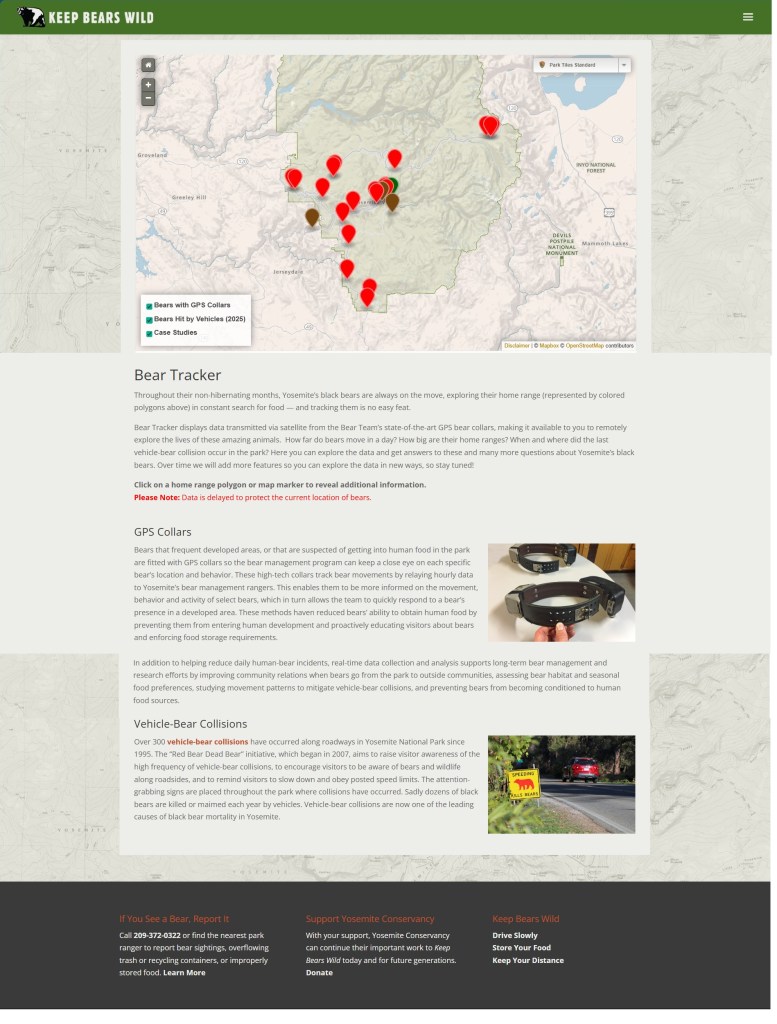
One of the testing sites for tracking black bears is Yosemite National Park.
Bear Tracker | Keep Bears Wild
Other Solutions to the Black Bear Problem
2. Population reduction by hunting helps control human–wildlife conflicts for a species that is a conservation success story

- Published: August 11, 2020
- https://doi.org/10.1371/journal.pone.0237274
- Abstract
- Introduction
- Materials and methods
- Results
- Discussion
- Conclusions
- Supporting information
- Acknowledgments
- References
Abstract
Among the world’s large Carnivores, American black bears (Ursus americanus) are the foremost conservation success story. Populations have been expanding across North America because the species is adaptable and tolerant of living near people, and because management agencies in the U.S. and Canada controlled hunting and other human-sources of mortality. As a result, human–black bear conflicts (damage to property, general nuisance, threat to human safety) have dramatically increased in some areas, making it urgently important to develop and deploy a variety of mitigation tools. Previous studies claimed that legal hunting did not directly reduce conflicts, but they did not evaluate whether hunting controlled conflicts via management of population size. Here, we compared temporal patterns of phoned-in complaints about black bears (total ~63,500) in Minnesota, USA, over 4 decades to corresponding bear population estimates: both doubled during the first decade. We also quantified natural bear foods, and found that large year-to-year fluctuations affected numbers of complaints; however, since this variation is due largely to weather, this factor cannot be managed. Complaints fell sharply when the management agency (1) shifted more responsibility for preventing and mitigating conflicts to the public; and (2) increased hunting pressure to reduce the bear population. This population reduction was more extreme than intended, however, and after hunting pressure was curtailed, population regrowth was slower than anticipated; consequently both population size and complaints remained at relatively low levels statewide for 2 decades (although with local hotspots). These long-term data indicated that conflicts can be kept in tolerable bounds by managing population size through hunting; but due to the bluntness of this instrument and deficiencies and uncertainties in monitoring and manipulating populations, it is wiser to maintain a population at a level where conflicts are socially-acceptable than try to reduce it once it is well beyond that point.
3. Breeding passive bears
Italian bears living near villages have evolved to
be smaller and less aggressive, finds study
Click on link to read
https://phys.org/news/2025-12-italian-villages-evolved-smaller-aggressive.html
 The Tahoe Bear